



Investment Memo

PaintJet Investment Memo

We created this Investment Memo to streamline the fundraising process and make it as easy as possible for everyone involved. If you’d like to learn more, please schedule a meeting to receive our pitch and metrics deck.

TL;DR

  • PaintJet is a construction robotics company focused on vertically integrating the global coatings market ($170B)
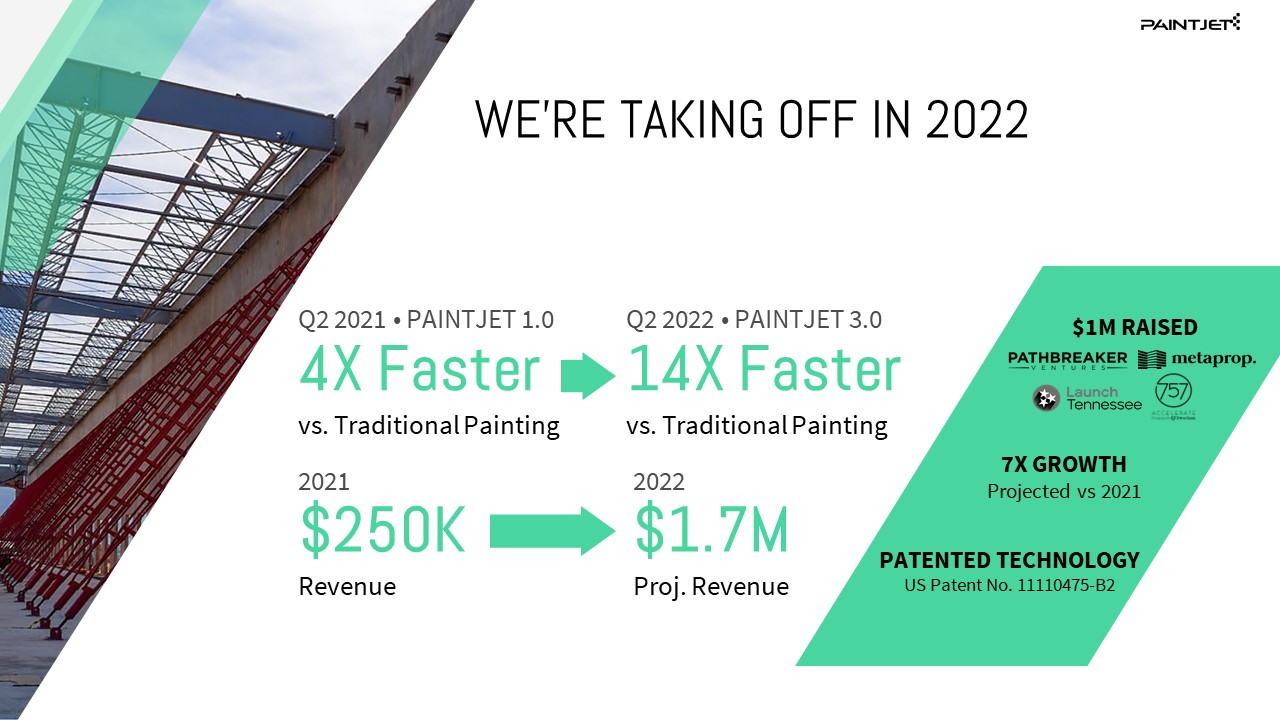
  • 7X projected growth vs 2021 realizing $1.7M by YE 2022
  • PaintJet V3 paints 14X faster than traditional methods (7,200 vs. 500 sqft/hr) while guaranteeing uniform application and reducing paint consumption by 25%
  • 1 patent awarded and 2 patents pending
  • Raising $3-5M

Summary

PaintJet is a vertically integrated painting robotics company addressing systemic labor shortages in the commercial and industrial painting industry.  PaintJet Paint is applied using PaintJet Robotics whose warranty is backed and repaint cycle is planned using PaintJet Imaging and Machine Learning.  Our technology is optimized for large scale commercial and industrial applications such as warehouses, storage tanks and marine applications where the cost to apply and emphasis on quality are highest.

Paint is everywhere.  The surface of every building, structure and mode of transportation must be protected against the elements.  Painting is how these structures are protected.  This is something that is needed, the demand for which is at an all time high.  Unfortunately, we do not have the number of skilled painters available to meet this demand.  The US will need over 100,000 new painters to meet current demand by 2026, and that does not take into account the fact that 41% of our current skilled labor force will retire by 2031.  The only option for meeting market demand is to automate the painting process, and that’s exactly what PaintJet does.

We recently launched PaintJet V3, which delivers a 14X productivity increase versus current industry best in class (7,200 vs 500 sqft/hr) and is fully remote controlled via the cloud.  PaintJet able to paint more square feet, with smaller teams, in a shorter amount of time, while reducing paint consumption by 25% and guaranteeing uniform coating application.

In 2022, we have secured over $2M in contracts.  We expect to realize $1.7M in revenue by the end of 2022, growing 7X vs 2021.  We anticipate this growth to continue over the next 5 years to achieve $75-100M within our initial market of large, new warehouse construction.  Technical efforts are focused on unlocking new, adjacent industries, including oil and gas, heavy industrial, marine and wind generation.

We are raising $3-5M to paint 1M sqft with the robot, professionalize our sales and marketing efforts, triple the size of our technical team and optimize coatings for robotic application.  At this time we are targeting value added leads with a track record of scaling robotics and material science companies into Series A and beyond.

PaintJet in Action

PaintJet integrates with industry standard manlifts widely available across the globe.  The robotic system latches onto the lift basket while the controls plug into universal connections in the lift control panel.  Both the robotic system and lift are remote controlled via the cloud and modified video game controller.

PaintJet operator painting 7,200 sqft/hr with the fully remote control system at our Nashville TN facility

PaintJet painting a new 300,000 sqft manufacturing facility outside of Birmingham AL

Management Team

Nick Hegeman

Co-Founder & CEO

Nick’s experience brings together the worlds of engineering and commercial painting.  After working for ExxonMobil as an Industrial and Sustainability Engineer, he started and eventually sold a commercial painting company.  It was this experience, and his continuous interaction with the systemic labor shortage in construction, that brought him back to his engineering roots and led to the creation of PaintJet.  The company’s primary focus started on delivering a 10X improvement to labor productivity through robotics and AI, but the fragmentation and inefficiencies of the coatings industry quickly revealed the need for a vertically integrated approach to corrosion prevention.

Dr. Sonia Chacko

Co-Founder & VP of Technology

Dr. Chacko leads PaintJet’s engineering efforts, combining her leading-edge PhD work with real world application.  Sonia has authored 12 peer-reviewed papers on robotics and augmented reality garnering 75 citations in the process.   Her work integrates the latest controls and imaging technologies with PaintJet’s robotic systems to provide best-in-class performance and ease of use for operators.  Before her academic work, she was an Embedded Systems Engineer focused on developing autonomous consumer products at international engineering company Robert Bosch.

Steve Wasilowski

Co-Founder & VP of Special Ops

Steve brings over a decade of painting industry expertise working in all aspects of the coatings industry value chain.  He started his career as a 2nd generation commercial painter working in product application, project management and estimating before becoming a Regional Production Management at CertaPro Painters.  There he oversaw $90M of annual painting production and worked with PaintJet Co-Founder Nick Hegeman.  He then worked with PaintZen and PPG in commercial sales and coating specification roles giving him paint manufacturing experience to add to his knowledge of field operations.

Investor FAQ’s

  • What is the opportunity in paint?

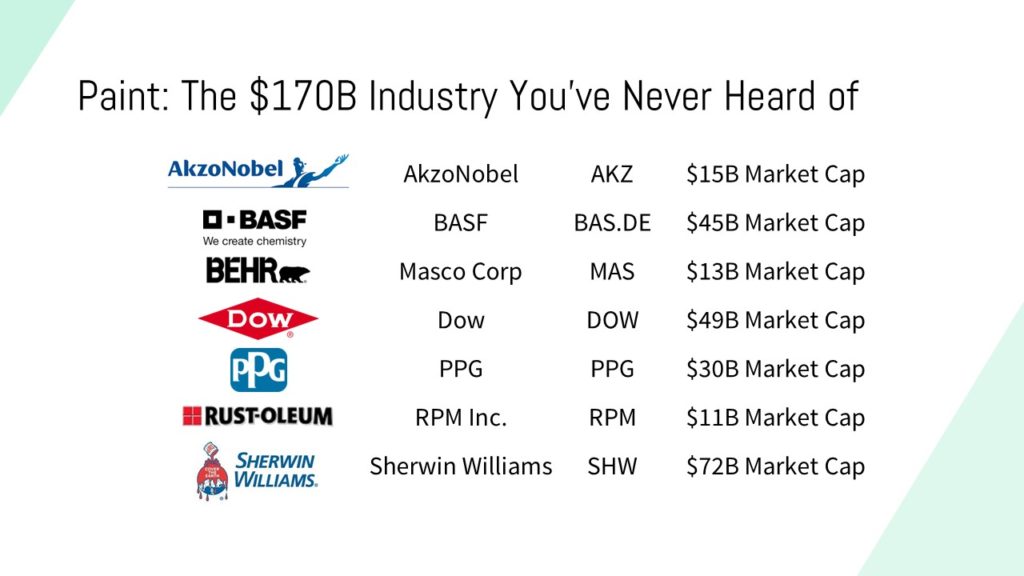
    Paint is all around us.  Buildings, bridges, towers, pipes, ships, cars, storage tanks and even concrete all must be painted to protect from corrosion and degradation.  Globally, paint accounts for $170B in annual revenue with multibillion, publicly traded companies populated throughout the Fortune 500.
     

  • What other construction robotics companies have been successful?

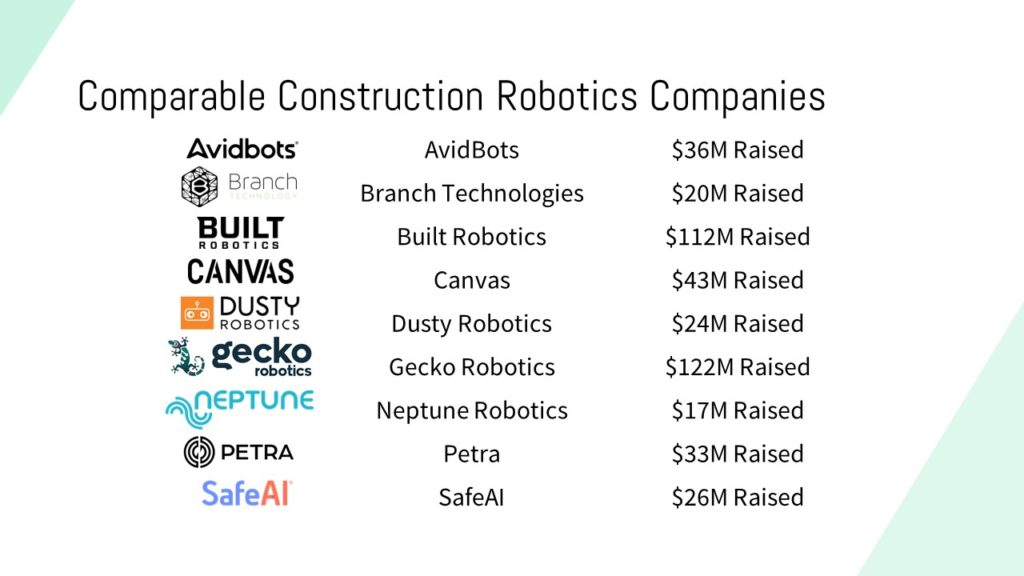
    Historically, robotics have been too expensive and unreliable to be used in the harsh working environment of the construction site.  Robotic affordability and performance have only recently reached a point where they are a viable option.  We believe that we are at the beginning of robotics and AI in construction, similar to Enterprise SAAS 15-20 years ago.  Construction robotics companies have recently experienced significant success and value creation for their customers and investors as Construction 2.0 begins to take shape.  Some of the more notable companies are shown below.
     

  • What does the competitive landscape look like?

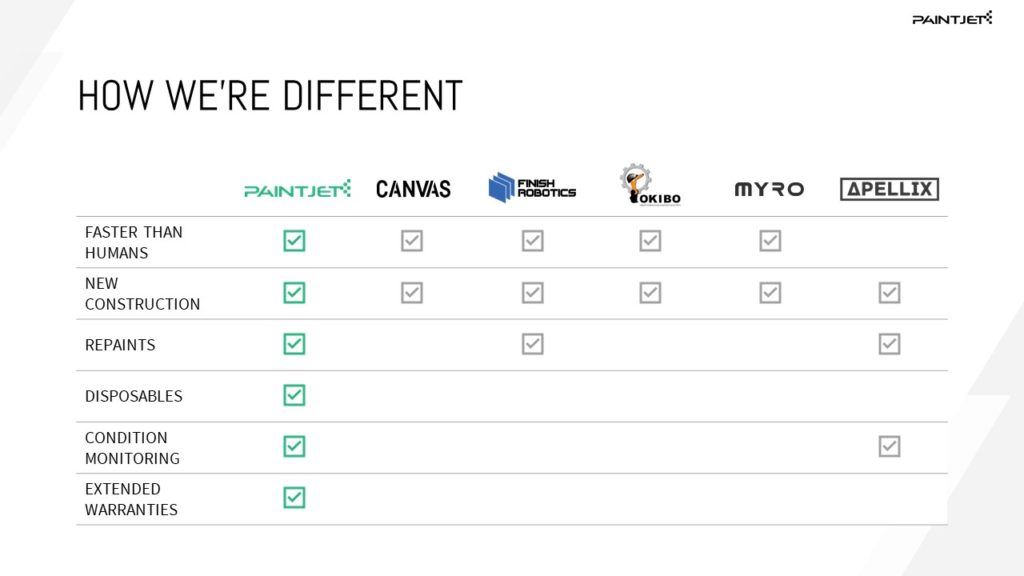
    Given the opportunity in the space, it is natural for the competitive environment to expand.  We believe we are uniquely positioned to beat competitors on multiple fronts:

    1. We focus on exterior painting.  Robotic arms (the primary method amongst competitors) are too heavy to lift off the ground.  Our integration of lightweight, modular end-effectors with industry standard manlifts gives us a unique advantage in the both variety of structures we can paint and the low cost of scaling over wide geographies.  Exterior painting also has higher quality standards, values specialty coatings and requires repainting every 6 years expanding our market potential.
    2. We are vertically integrated.  We optimize throughout the entire value chain.  Whereas our competitors typically focus on a single aspect of the coating process (application, inspections, finishing, formulation), we bring multiple facets to a single point of contact.  This eliminates fragmentation and inefficiencies while maximizing value to the asset owner.
    3. Our team is unique in its expertise in both paint and robotics.  Our competitors are smart and technically competent, but it is rare that they have extensive 1st hand knowledge of actual construction sites.  We're different in that we have both PhD technical expertise and decades of paint industry experience in the founding team.


  • How do technical advances enhance the market opportunity?

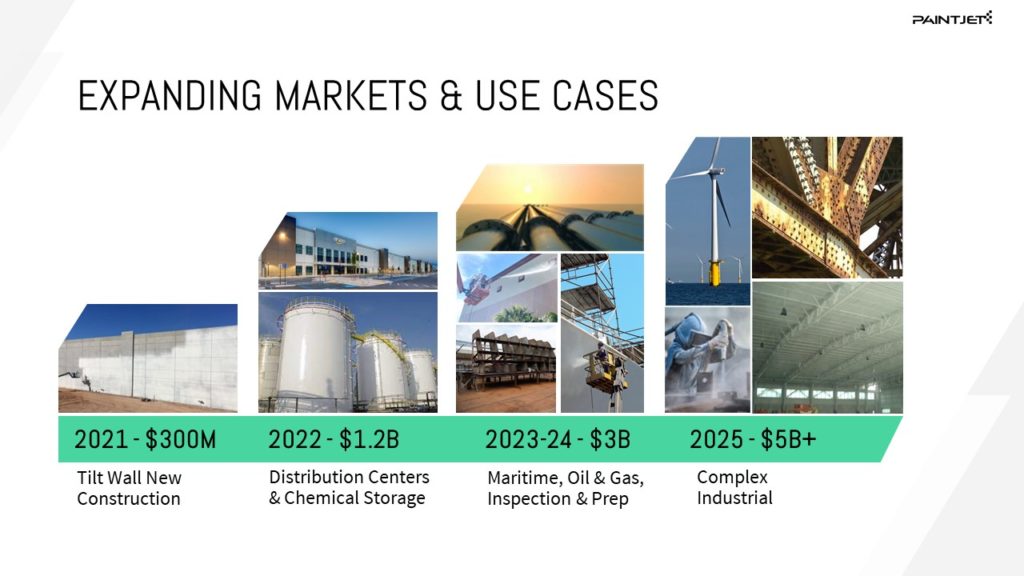
    One of our core strategies is to be able to generate revenue today.  There are numerous examples of dead robotics companies who focused on achieving full autonomy before entering the market.  Most of the time, they are unable to deliver on that lofty goal and run out of cash.  We focus on the large, niche applications suited for our technology.  Below shows how continued investment in our technical development expands our total addressable market in a sustainable way.
     

  • How do margins evolve over time?

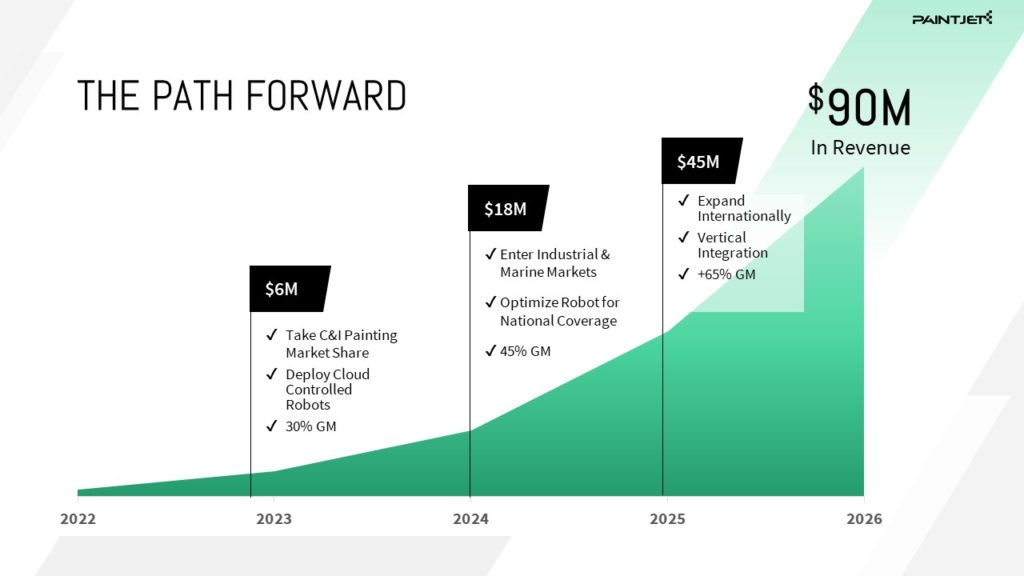
    The construction industry is extremely fragmented and risk averse.  In order to take market share, we are pricing ahead of our technical capabilities, often undercutting the market by over 20% to secure a new customer.  As a result, current margins are 30%.  Over time, we expect margins to increase in excess of 60% as our technical capabilities increase and the ongoing labor supply shortage raise overall market pricing.  Vertically integrating coating manufacturing will add an additional 5-10%, bringing our long-term margins in line with traditional software companies.


  • What does the sales cycle currently look like?

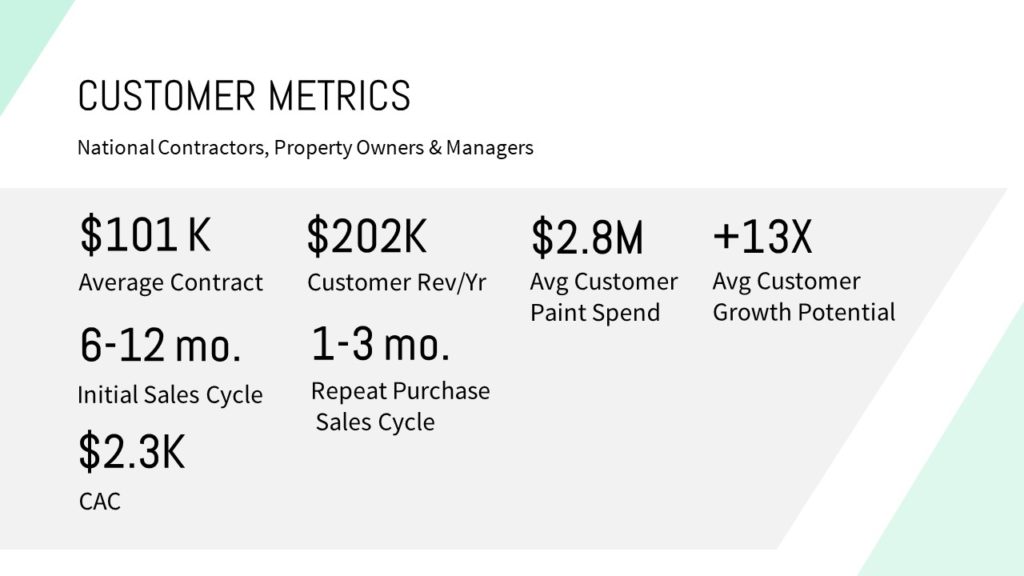
    They most difficult contract to secure is a new customer's first contract.  Signing up a new customer currently takes between 6-12 months.  Not only does that first contract take the longest, but it is also typically the smallest in revenue.  However, once the first contract is executed, we see a 75% reduction in the sales cycle for repeat contracts and an increase in the overall contract size.

    Our primary customers are large, national general contractors who spend millions of dollars in paint every year.  Once becoming a preferred vender, it is not uncommon to be awarded +75% of their total paint spend.  We currently have less than 10% of our current customer paint spend, representing growth potential of more than 13X even if we never added another customer.  We expect all of these metrics to improve as part of the raise is being allocated to professionalizing our sales and marketing efforts.
     

  • Why is this a VC business and not a contracting business?

    PaintJet, at its core, is a robotics, AI and material sciences company vertically integrating the entire painting value chain.  While initial revenue sources may  appear similar to a technology enabled contractor, the long term size, scale and profitability is comparable to traditional venture backed entities.  In the long run, PaintJet will apply next gen coatings to infrastructure around the world with the push of a button, generating hundreds of millions in revenue and earnings.  


  • What's are the next steps for PaintJet?

    Our immediate focus is on  taking commercial painting market share while we continue to demonstrate and expand technical capability in the field.  We will be professionalizing our sales and marketing processes to further accelerate our growth while in parallel begin laying the foundation to incorporate a vertically integrated service offering with strategic partners in adjacent markets.
Thank you for taking the time to review our PaintJet Investment memo.  If you found any of this interesting and would like to discuss more, please email our CEO and Co-Founder, Nick Hegeman, at nick@staging.paintjet.com or click on the link below to schedule a quick 30 minute meeting.